
The Invisible Architecture: Mapping the Global Nervous System
For centuries, we have been taught to see the world as a collection of separate islands. A planet is a rock isolated in the void. A photon is a discrete particle of light. A mood is a private thought locked inside a bone tower. We built our entire civilization on this Island Logic, believing that if we could just fix the individual parts, the whole would take care of itself.
The data emerging in 2026 is dismantling that map. Three major breakthroughs this month, stretching from the deep reaches of space to the internal chemistry of our own bodies, are revealing an architecture that connects everything. This is not just science news. It is the climax of a massive shift in how we understand reality.
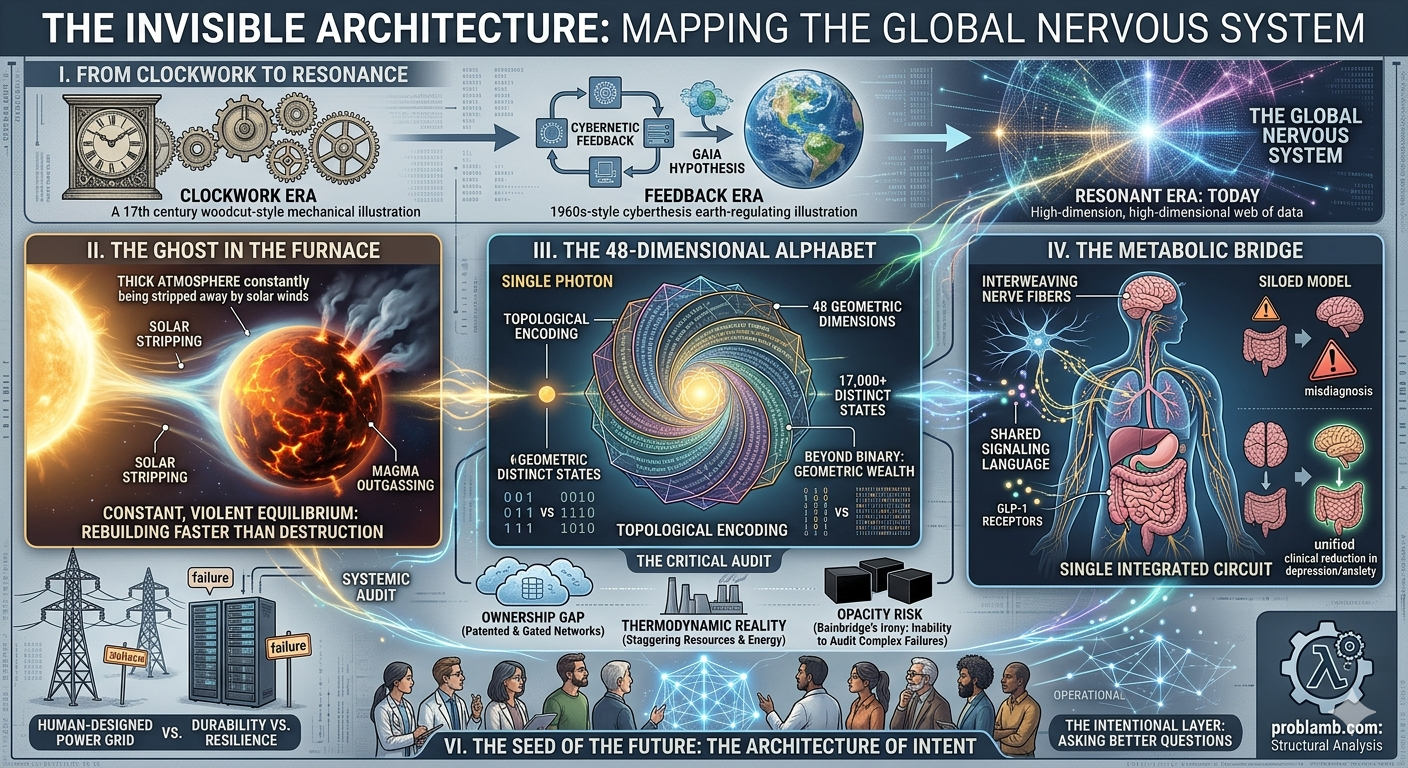
I. The Evolution: From Clockwork to Resonance
To understand why this matters now, we have to see how our map of the world has evolved. We are not just getting better at science. We are changing our fundamental perspective on how things work.
The Clockwork Era (17th to 19th Century). Inspired by Newton, we saw the universe as a giant machine. If a clock breaks, you find the gear that failed and replace it. In this era, invisible connections were dismissed as magic. If you could not see the gear, it did not exist.
The Feedback Era (1940s to 1990s). Early systems thinkers and the Gaia Hypothesis suggested the world was more like a circuit than a clock. They realized that biological systems did not just exist. They maintained themselves through feedback loops. The planet was not a passive rock; it was an active regulator.
The Resonant Era (Today). We have moved past theorizing. We are now mapping the actual high-dimensional blueprints. Three specific breakthroughs this month prove that the universe is not just connected. It operates as a single, high-speed nervous system where every part is in constant exchange with the whole.
II. The Ghost in the Furnace
The exoplanet TOI-561 b sits so close to its star that its entire surface is a sea of molten magma. Standard models of planetary physics are unambiguous: at those temperatures, solar radiation strips atmospheric gases away permanently. The planet should be a bare, airless rock.
It is not. The James Webb Space Telescope has confirmed a thick, persistent atmosphere clinging to that furnace.
The reason matters more than the discovery. The atmosphere is not surviving because it is shielded or protected. It is surviving because it is being destroyed and replaced in real time. The magma ocean below is continuously outgassing new material at a rate that matches the solar stripping. The planet is not stable. It is in a state of constant, violent equilibrium.
The hidden problem. Human infrastructure is built on the assumption that stability means rigidity. We engineer power grids, supply chains, and server networks to withstand a defined maximum load. When that load is exceeded, the system does not adapt. It fails. We have spent generations confusing durability with resilience.
The hidden solution. TOI-561 b does not endure through strength. It endures through speed. The replacement cycle is fast enough to make destruction irrelevant. The architecture that survives extreme environments is not the one that resists change. It is the one that can rebuild itself faster than it is being taken apart.
III. The 48-Dimensional Alphabet
For decades, computing has operated on binary logic: a signal is either on or off. One or zero. This is not a software limitation. It reflects a genuine assumption about the physical nature of information, that data lives in the presence or absence of a signal, not in the signal itself.
Researchers working with the orbital angular momentum of light have found that assumption to be catastrophically incomplete. A single photon does not carry one bit of information. It carries a geometric structure, a specific twist and shape in its topology, that can encode an enormous number of distinct states simultaneously. The team mapped 17,000 of them. The theoretical ceiling is far higher.
The hidden problem. We are hitting a physical ceiling on data. Our cables and chips are not slow. They are dimensionally exhausted. We have been trying to move a civilization’s worth of complexity through a system that only recognizes two states. The bottleneck is not bandwidth in the conventional sense. It is geometric poverty. We built our entire information infrastructure on a two-letter alphabet and are now surprised we cannot write the books we need.
The hidden solution. Nature does not solve the density problem by adding more wires. It adds more dimensions to the signal itself. The geometry of the carrier becomes the information. This is not a faster version of what we already have. It is a fundamentally different relationship between physical reality and data, one where the shape of a thing carries as much meaning as its presence or absence.
IV. The Metabolic Bridge
A study involving tens of thousands of patients has confirmed something that challenges a century of psychiatric practice. Semaglutide and related GLP-1 receptor agonists, drugs developed to regulate blood sugar and reduce body weight, are substantially lowering rates of depression and anxiety in patients who take them. The mental health effect is not a minor footnote. In some cohorts it approaches 40 percent.
The reporting frames this as a surprise. It should not be, but the surprise itself is revealing. The reason it reads as unexpected is that we built modern medicine around a strict separation between the body and the mind. Metabolic drugs fix the gut. Psychiatric drugs fix the brain. The data from GLP-1 research says that distinction is false.
The hidden problem. The silo model of medicine does not just produce inefficiency. It produces misdiagnosis at scale. When we treat mood as a psychological phenomenon and metabolism as a physical one, we look for solutions inside the wrong system. We chase the signal while leaving the source of the noise untouched. The result is that millions of people receive treatment for the output of a problem while the underlying circuit dysfunction continues unaddressed.
The hidden solution. The gut and the brain are not parallel systems with occasional communication. They are a single integrated circuit with a shared signaling language. When the metabolic component of that circuit is destabilized, the neurological component produces noise. When metabolic stability is restored, the neurological signal clears. The intervention point and the symptom location are not the same place, and the distance between them is where a century of treatment has been getting lost.
V. The Critical Audit: The Next Great Complexity Wall
Taken together, these three breakthroughs point toward a world of systems that are more resilient, more information-dense, and more integrated than anything we have built before. That is worth being clear-eyed about.
The ownership gap. Any 48-dimensional data infrastructure or metabolic monitoring network will be owned, patented, and gated by private interests. The architecture may be invisible, but the access controls will not be. We are not simply becoming nodes in a network. We are becoming tenants in one, subject to terms we did not write and cannot fully audit.
The thermodynamic reality. Complexity is not free. The dynamic persistence model of TOI-561 b requires a constant, uninterrupted energy supply. A system that survives through continuous replacement is entirely dependent on its replacement rate never lagging. Training the models required to operate 48-dimensional encoding requires staggering computational resources, rare earth materials, and energy infrastructure. The architecture may feel weightless in the abstract. On the ground it is anything but.
The opacity risk. As these architectures become more capable, they become less legible. A human engineer can trace a fault in a binary data stream. A human clinician can follow the logic of a serotonin reuptake inhibitor. Neither can intuitively audit a 48-dimensional topological encoding or a full-stack metabolic-neurological intervention. We are building systems whose failure modes we cannot visualize in advance. The Irony of Automation, identified by researcher Lisanne Bainbridge in 1983, holds that the more reliable a system becomes, the less capable its operators are of intervening when it breaks. We are accelerating toward that wall.
VI. The Seed of the Future: The Architecture of Intent
If the universe can maintain its own atmosphere, encode libraries into the geometry of light, and regulate a mind through a gut, then the operational question shifts. The 20th century asked humans to be operators: turn the dials, maintain the systems, correct the errors. As the Invisible Architecture absorbs more of that operational layer, a different kind of human capacity moves to the front.
Humans will always be the ones who decide what gets built. That has not changed and will not. What is changing is the nature of that decision. When you no longer spend the majority of your cognitive energy on execution, the question of intent becomes the primary creative act. A 48-dimensional photon is a mathematical object until someone decides what it should carry and why. A metabolic intervention is a chemical event until someone decides which population needs it and on what terms. A planet surviving its star is thermodynamics until a human mind asks what it means for how we build.
This is not a threat dressed up as an opportunity. It is a genuine structural shift in where human creativity lives. For most of recorded history, the highest leverage point was execution: the engineer who could build the bridge, the surgeon who could perform the procedure, the programmer who could write the code. Those skills still matter. But as systems become capable of executing at levels no individual human can match, the highest leverage point moves upstream, to the person who can hold a clear and honest picture of what the system is for.
That is a creative act in the deepest sense. It requires the ability to sit with complexity without being dissolved by it, to maintain a low-dimensional, human-scale understanding of purpose inside an environment of high-dimensional, automated capability. The people who can do that, who can articulate intent precisely enough to direct systems they cannot fully see, are not being replaced by the Invisible Architecture. They are the ones who give it direction.
That is where the next generation of creativity lives. Not in competing with the machine on its own terms, but in asking better questions than the machine is capable of asking. The operational layer is becoming invisible. The intentional layer is becoming everything.