
Salmon, Beavers and Antibiotics: The Regeneration Paradox
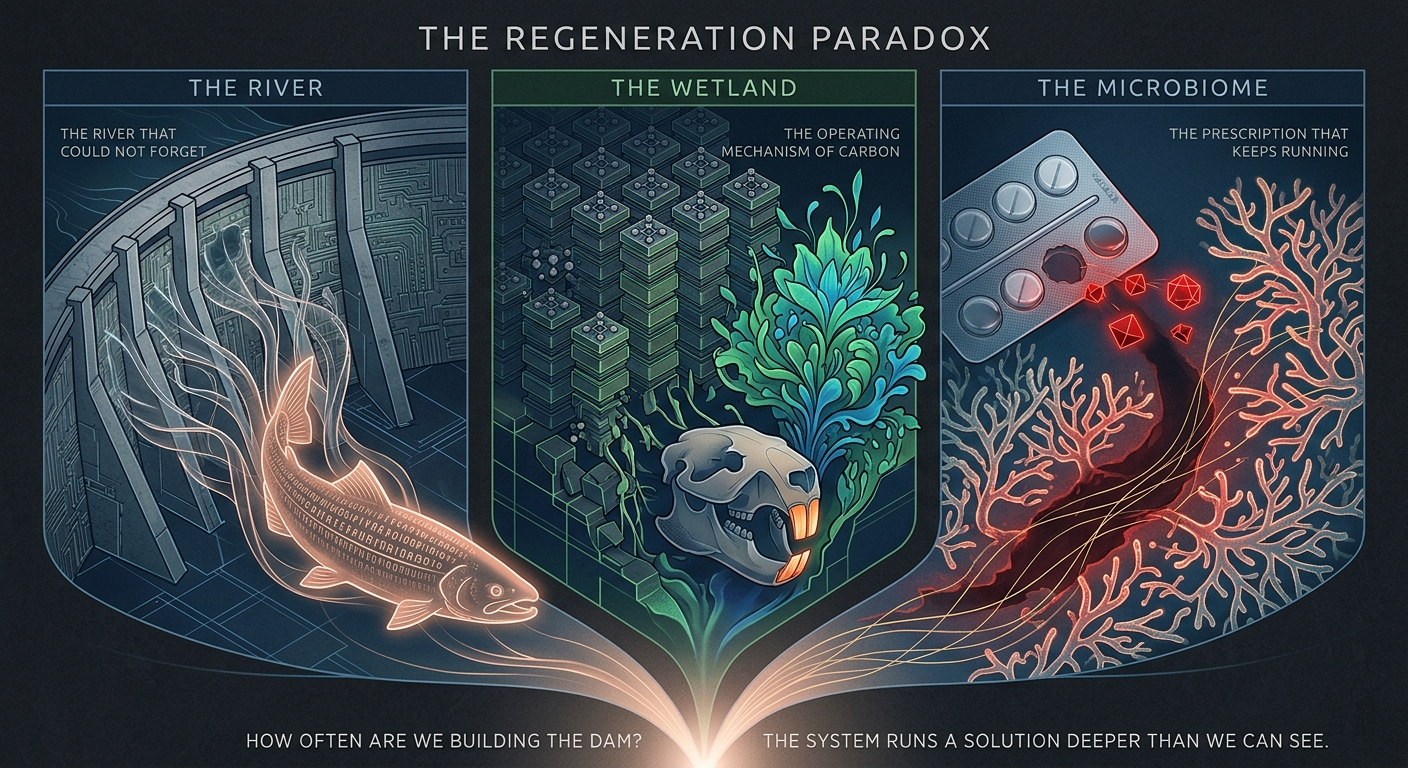
For a hundred and six years, the Chinook salmon of the Klamath River in northern California carried that knowledge with nowhere to put it. Four dams built between 1911 and 1964 had blocked the upper river completely. The fish could detect where they were supposed to go. They simply could not get there. The population collapsed. Fall runs dropped ninety percent, spring runs ninety-eight. For a century, fisheries managers tried to compensate. Stocking programs. Fishing restrictions. Habitat restoration. Millions of dollars, decades of effort, teams of scientists counting and tagging and releasing. The salmon population on the Klamath remained a fraction of what it had been. None of it worked, because none of it addressed the actual problem.
The dams came down in 2024. Within months, something happened that all that management had never achieved. Salmon appeared in the Wood River, the Williamson, the Sprague, tributaries that had been unreachable for over a century. They spawned in cold-water spring complexes around Upper Klamath Lake. More than ten thousand Chinook passed the former site of Iron Gate Dam in the first year alone, thirty percent more than the year before, arriving weeks earlier than any previous season. The coalition of tribal nations and scientists watching the river reported, in careful scientific language, that what they were seeing was faster and more powerful than anyone had expected.
What nobody had fully understood, until the absence of the dams made it visible, was that the river itself had been the restoration program all along. The salmon didn’t need the stocking. They needed the door opened. Everything required for the return, the instinct, the route, the timing, the spawning knowledge encoded across millions of years of evolution, had survived the century of obstruction intact. The fish knew exactly what to do. They had always known. The management had simply been in the way.
I. The River That Could Not Forget
For a moment, stand on the bank and take that in. A fish navigating home through magnetic memory, across a thousand miles of open ocean, to a river that had been sealed for longer than most living humans have been alive. The instinct didn’t fade. It waited.
The stocking programs and fishing restrictions were not foolish. They were the rational response to a visible problem: not enough salmon. Managing the output of a failing system is what competent people do when they cannot fix the system itself. The question the Klamath recovery raises is not why the managers got it wrong. It is why removing one thing, the dams, produced results that a century of active intervention hadn’t approached.
The dams were not blocking the salmon. They were replacing the river. Everything the Klamath needed to sustain its fish population, the sediment dynamics, the temperature gradients, the specific migration corridors through specific tributaries, had been built over millennia by the river running itself. When the dams arrived, those processes didn’t degrade. They stopped. The stocking programs that followed were working on the downstream symptom of that loss without ever reaching its source.
The visible problem was declining fish numbers. The real problem was a river that had been replaced. Nobody could fix a river they didn’t know was missing.
II. The Best Climate Policy in Europe Has Orange Teeth
Beavers were once found across virtually every river system in Europe. They were hunted to near-extinction for their fur over several centuries, a process essentially complete by the early twentieth century. When they were gone, they left quietly. Nobody was measuring what they had been doing to the landscape, because nobody thought of them as doing anything in particular beyond building dams in streams. They were animals. That was about the extent of it.
Researchers from the University of Birmingham, Wageningen University and the University of Bern spent thirteen years measuring what a single beaver family in a stream corridor in northern Switzerland had actually been doing. The numbers in their study, published in Communications Earth and Environment, are the kind that make you read the sentence twice.
Over those thirteen years, the wetland the beavers engineered stored an estimated 1,194 tonnes of carbon, at a rate up to ten times higher than equivalent landscape without beaver activity. The sediments they created held fourteen times more inorganic carbon and eight times more organic carbon than nearby forest soils. Methane emissions, the standing concern with any wetland carbon calculation, came in at less than one tenth of one percent of the total budget. When the researchers scaled what this one family demonstrated across all Swiss floodplains suitable for beaver recolonisation, they estimated it could offset between 1.2 and 1.8 percent of Switzerland’s entire annual carbon emissions. Without any technology. Without any subsidy. Without any infrastructure beyond the presence of the animal doing what it has always done.
Europe has spent thirty years and billions of euros on carbon capture programs. Managed forests, engineered wetlands, offset markets, direct air capture technology. These are serious efforts by serious people on a genuinely urgent problem. Not one of them has come close to the efficiency of what thirteen years of one beaver family produced in one Swiss stream corridor.
The beaver wasn’t only a species that was lost. It was the operating mechanism of a carbon system that had been running across European river landscapes since the last ice age, sequestering carbon at rates that no human program has yet matched, building wetland infrastructure whose value nobody had thought to calculate before the animal that built it was gone. The programs constructed in its absence were solving a problem the beaver had already solved, without any record of that solution having existed.
Once hunting pressure stopped and beaver populations began recovering, the system rebuilt itself without instruction. The animal returned to the river and the carbon infrastructure came with it. The management that produced ten times the output of managed programs was the decision to step back.
III. The Prescription That Keeps Running
Gabriel Baldanzi is a researcher at Uppsala University in Sweden. His team spent considerable time cross-referencing what nearly fifteen thousand people carry in their gut today against what medications they took in previous years, using the kind of national drug registry that Scandinavian countries are uniquely positioned to maintain. The gut microbiome, the vast community of bacteria living in every human digestive system, involved in immune regulation, metabolic function and a growing list of other processes that medicine is still mapping, showed up differently in people who had taken certain antibiotics years earlier. Measurably differently. The worst effects appeared in the first year after a course of treatment, but in some cases the traces were still clearly visible four, five, six, seven years later. In some patients, close to a decade.
One course. One infection. Long since cleared. And the body’s internal ecosystem was still carrying the record.
This finding needs to be read carefully, because it is easy to misread. Antibiotics save lives. That is not a mild point. It is one of the central facts of modern medicine, and nothing in the Uppsala data touches it. The researchers said clearly that patients should not stop taking prescribed medications. Their practical conclusion was specific: when two antibiotics are equally effective against an infection, the data argues for choosing the one with less microbiome impact. Not fewer antibiotics. More considered ones.
But what the data reveals underneath that careful conclusion is the same gap the Klamath and the beavers revealed. The antibiotic was designed and evaluated to treat a pathogen, on the timescale of the infection. It treated it. What nobody was measuring at the point of prescription was the system the antibiotic was passing through, a community of trillions of organisms whose functions medicine is still discovering, running on timescales that have nothing to do with the duration of an infection. The gut microbiome was keeping a record that no blood test at the clinic was reading. That record, it turns out, extends for years beyond the moment the prescription ended.
Unlike the Klamath and the Swiss wetland, there is no recovery story here yet. The Uppsala data doesn’t show the microbiome bouncing back the way the river bounced back. What it shows is something earlier and less resolved: the depth of the system becoming newly visible through tools that didn’t exist when those prescriptions were written. We are not at the end of this story. We are at the moment of recognising that the story is longer than anyone thought.
A growing movement in medicine has been organising around exactly this recognition for decades. Integrative medicine, built on the understanding that treating a human body means treating a system whose depth exceeds any single clinical frame, has grown from a fringe position into a significant institutional presence. Eighty-six academic institutions across six countries now operate under the Academic Consortium for Integrative Medicine and Health. The Uppsala study is the kind of data that gives that movement weight.
IV. Three Stories, One Gap
The salmon knew where to go when the dams were still in place. They just couldn’t get there. The beaver knew how to build carbon infrastructure. Europe just didn’t know it had been building it. The gut microbiome knew how to regulate itself across timescales medicine hadn’t yet thought to measure.
In two of the three cases, removing the obstacle was enough. The system did the rest.
What the Evidence Has Not Settled
The Klamath monitoring data is preliminary. One year of strong salmon returns is a beginning, not a conclusion. The long-term population trajectory will take years of careful monitoring to understand.
The beaver study was conducted at a single site. One family in one Swiss stream corridor over thirteen years is a striking result, but how it scales across different geographies, climates and river types remains to be established. The researchers say so directly.
The Uppsala microbiome study shows association, not proven causation. Reduced bacterial diversity after antibiotic use does not establish that the people affected were harmed by it. The connection between microbiome disruption and downstream disease risk, suggested by prior research, is not mechanistically confirmed by this study. The picture is strongly suggestive. It is not complete.
What those caveats don’t change is the direction all three are pointing. The systems being managed turned out to be deeper than the measurement being taken. In two cases the depth is now unambiguous. In the third it is accumulating.
There is something quietly humbling in all three of these stories, once you sit with them long enough.
The people who built the Klamath dams were not careless. The people who hunted beavers were feeding families and supplying markets that depended on them. The doctors writing antibiotic prescriptions were treating real infections that would have harmed or killed without intervention. In each case the decision made sense. In each case the intent was sound. And in each case, the system being entered was running processes so much older and deeper than the problem being solved that the intervention, rational, well-intentioned, effective at its stated purpose, quietly displaced something it had no idea was there.
This is not an argument against intervention. It is something more interesting than that. It is an observation that our instinct to act, to manage, to improve, to fix, which is one of the finest things about us, can sometimes prevent exactly the recovery it is trying to produce. The effort itself can become the obstacle. The river, given the chance, knew things the engineers didn’t. The beaver, left alone, built what the climate programs couldn’t. The body, given space, runs processes medicine is only now beginning to measure.
The salmon returning to the Klamath are not a conservation success story in the conventional sense. Nobody bred them. Nobody guided them. Nobody improved their genetics or trained their instincts or showed them the route. The scientists who watched them arrive were, by their own account, astonished. What the salmon demonstrated was not the triumph of restoration. It was the persistence of knowledge that human management had never possessed and could not have supplied, knowledge encoded over millions of years into the biology of a fish, waiting quietly for the obstacle to be removed.
The question that leaves open is one worth carrying. When we intervene in systems we don’t fully understand, and we always intervene in systems we don’t fully understand because no human understanding is ever complete, how often are we building the dam? How often is the thing we are trying to fix already running a solution deeper than we can see?
The salmon knew. The beavers knew. The gut microbiome, in its patient way, is telling us it knows too.
We are still learning to listen.